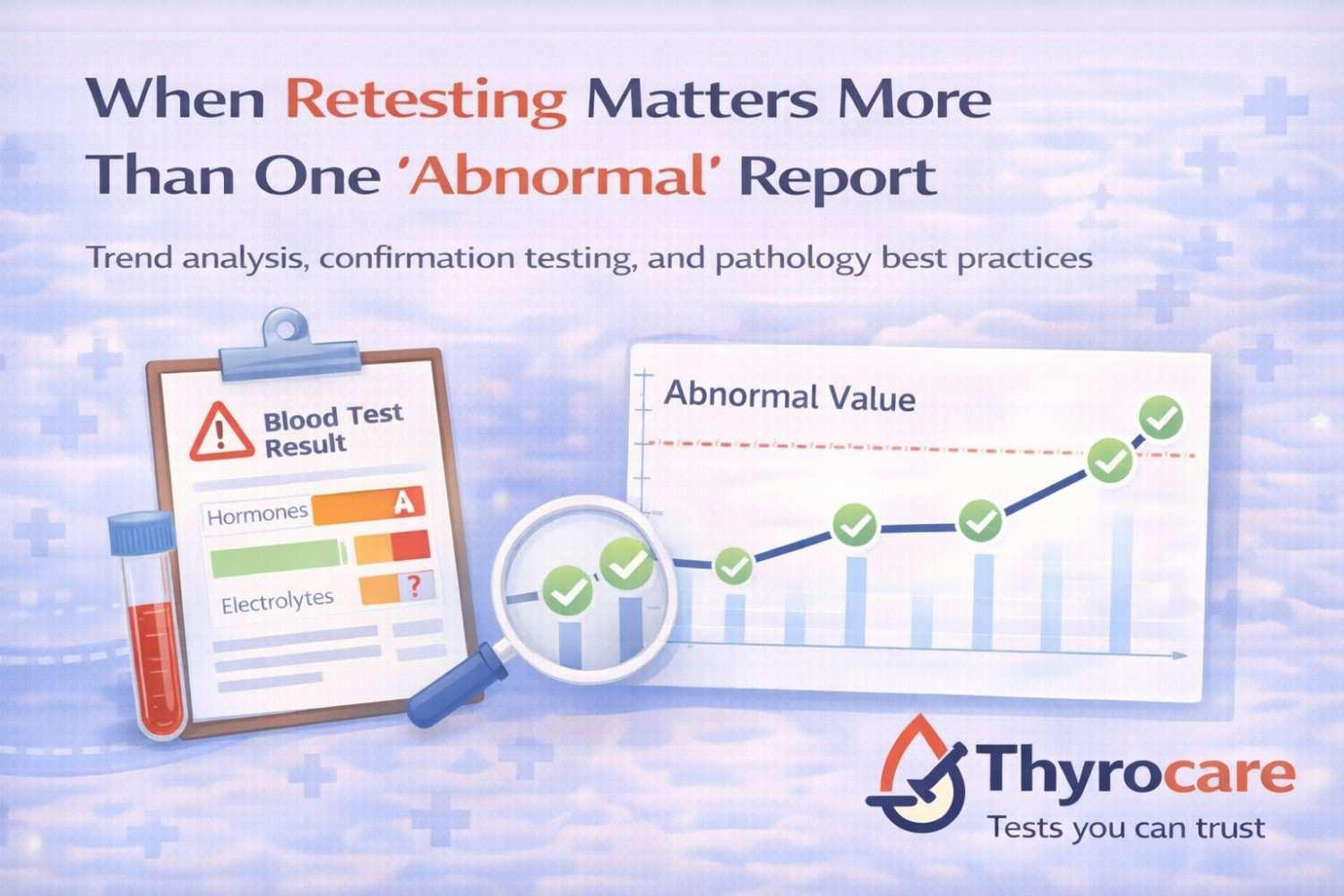
When Retesting Matters More Than One ‘Abnormal’ Report
Seeing the word abnormal on a blood test report can be unsettling. For many people, it immediately triggers worry—even when they feel perfectly fine. However, in diagnostics, one abnormal value rarely tells the full story. In many cases, retesting and observing trends over time is far more meaningful than reacting to a single report.
Why One Report Isn’t Always Definitive
Blood tests capture a snapshot of the body at a specific moment. Temporary factors such as hydration, timing, recent activity, or even minor physiological fluctuations can influence results. An isolated abnormal value may reflect these short-term variations rather than a true underlying issue.
Understanding Normal Biological Variation
Every individual has a natural range within which blood values move. These values are not fixed points. A result slightly outside the reference range does not automatically indicate a problem—it may simply fall at the edge of normal biological variability.
The Importance of Trend Analysis
Pathologists and doctors place greater importance on patterns over time rather than single readings. When results are tracked across multiple tests, trends become clearer. Stable values, gradual shifts, or consistent changes provide far more diagnostic insight than one-off numbers.
Why Confirmation Testing Is a Best Practice
Confirmation testing helps differentiate between temporary changes and true abnormalities. Retesting under similar conditions—same time of day, similar preparation—adds clarity. This approach prevents unnecessary concern and supports accurate clinical decision-making.
Avoiding Overinterpretation of Isolated Results
Reacting immediately to a single abnormal value can lead to unnecessary stress and additional testing. Diagnostic best practices encourage context, comparison, and follow-up rather than conclusions based on one report alone.
When Retesting Becomes Essential
Retesting is particularly important when values are borderline, unexpected, or inconsistent with how a person feels clinically. It helps confirm whether a result represents a genuine trend or a temporary deviation.
How Laboratories Support Accurate Follow-Up
Accredited laboratories maintain consistency in testing methods, calibration, and quality control. This consistency ensures that repeat tests are comparable, allowing doctors to rely on trends rather than guesswork.
Trusted Retesting with Thyrocare
Thyrocare follows strict laboratory protocols that support reliable trend analysis and confirmation testing. When you book a Thyrocare blood test through BookMyTest, samples are collected at home under standardised conditions, and digital reports are delivered within 24 to 48 hours, making follow-up testing convenient and dependable.
Conclusion
An abnormal report is not always a final answer—it’s often a starting point. Retesting allows healthcare providers to understand patterns, confirm findings, and avoid unnecessary conclusions. In diagnostics, clarity comes from consistency, not a single number.
FAQs
Why do doctors recommend retesting after an abnormal Thyrocare blood test?
Because a single Thyrocare blood test report may reflect temporary variation rather than a true health issue. Retesting helps confirm trends.
Is Thyrocare home sample collection suitable for repeat testing?
Yes. Thyrocare home sample collection follows the same quality standards for repeat and confirmation tests.
How soon should I repeat a Thyrocare blood test if results are abnormal?
The timing depends on the parameter tested. Doctors often advise follow-up testing after a short interval to assess trends in Thyrocare blood test results.
Can I book repeat Thyrocare blood tests at home through BookMyTest?
Yes. You can easily schedule repeat Thyrocare blood tests at home via BookMyTest.
How quickly are repeat Thyrocare test reports available?
Most Thyrocare blood test reports are delivered digitally within 24 to 48 hours, including follow-up tests.