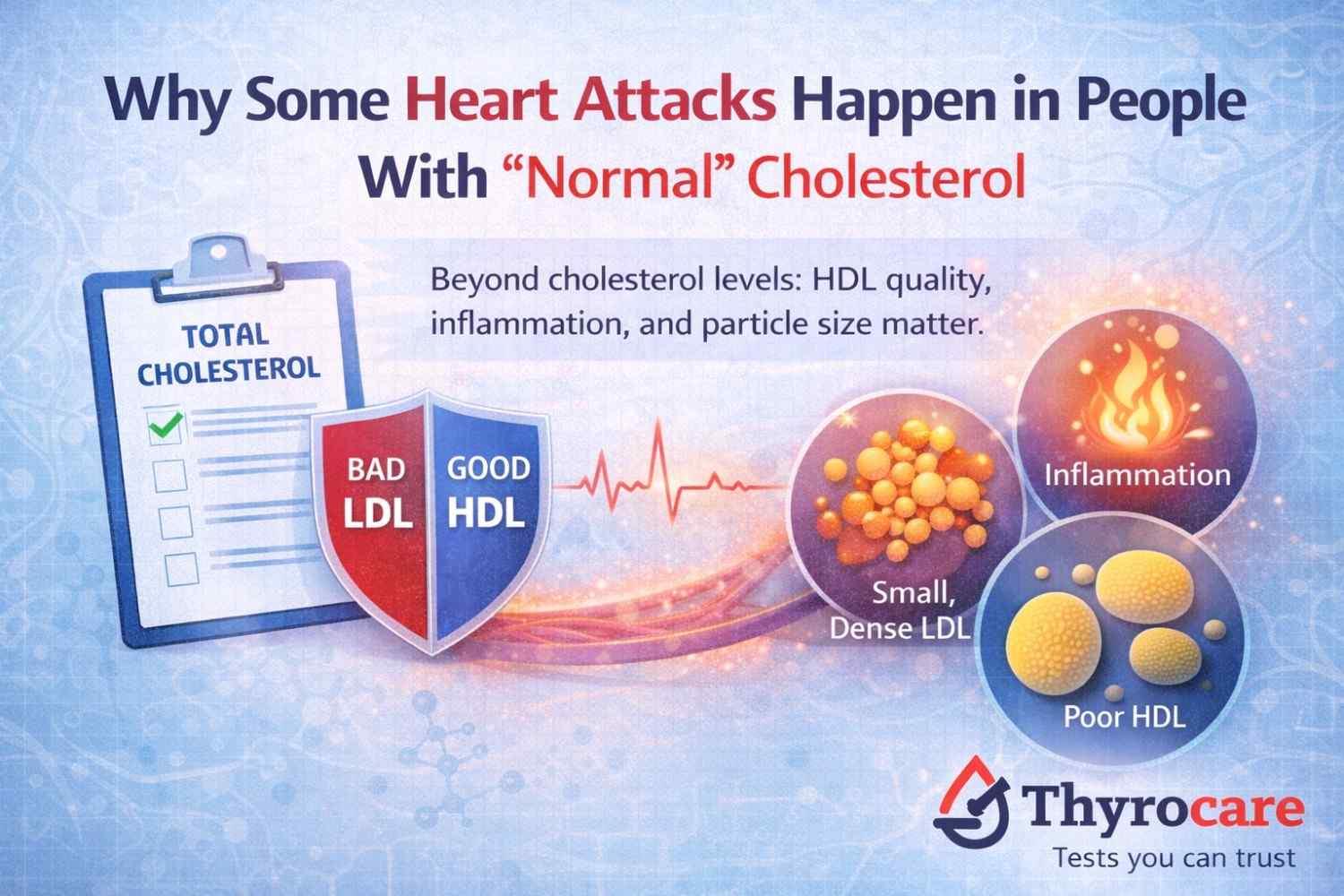
Why Some Heart Attacks Happen in People With “Normal” Cholesterol
Many people feel reassured when their cholesterol report says “normal.” It creates a sense of safety—almost like a clean bill of heart health. Yet, heart attacks sometimes occur in individuals whose total cholesterol levels fall within standard reference ranges. This doesn’t mean cholesterol doesn’t matter. It means total cholesterol alone doesn’t tell the complete story.
Understanding what lies beyond that single number is essential for preventive heart awareness.
Total Cholesterol Is Only a Summary Number
Total cholesterol combines different lipid components into one figure. While useful, it doesn’t reveal how those components behave individually. Two people with identical total cholesterol values can have very different cardiovascular risk profiles depending on how their lipids are structured and functioning.
The deeper story lies in lipid patterns—not just totals.
HDL Quality Matters, Not Just Quantity
High-density lipoprotein (HDL) is often referred to as “good cholesterol.” However, it’s not only the amount of HDL that matters but how effectively it performs its protective role.
Healthy HDL helps remove excess cholesterol from arteries and reduces inflammation. If HDL function is impaired—even when levels appear normal—its protective effect may be limited. This is why some individuals with normal lipid numbers still experience vascular risk.
LDL Particle Size and Behavior
Low-density lipoprotein (LDL) is typically associated with heart risk. But beyond quantity, particle size and density play a role. Smaller, denser LDL particles are more likely to penetrate artery walls and trigger inflammatory responses.
Standard cholesterol reports may not always reflect this nuance, which explains why risk can exist despite “acceptable” totals.
The Role of Inflammation
Heart disease is not only about fat accumulation—it also involves inflammation. Chronic low-grade inflammation can destabilize plaque inside arteries, increasing the likelihood of rupture.
Inflammatory markers can signal vascular stress even when cholesterol numbers look reassuring. This combination—normal cholesterol with elevated inflammation—can still increase cardiovascular risk.
Why Relying on One Marker Is Risky
Cardiovascular health depends on multiple interacting factors: lipid patterns, inflammation, metabolic balance, and endothelial function. Focusing only on total cholesterol can create a false sense of security.
A comprehensive assessment provides better insight than a single reassuring number.
Preventive Insight with Thyrocare
Thyrocare offers comprehensive lipid and preventive health testing that goes beyond total cholesterol values. When you book a Thyrocare blood test through BookMyTest, trained professionals collect samples at home, and digital reports are delivered within 24 to 48 hours, supporting informed cardiovascular risk discussions.
Understanding lipid patterns and inflammatory markers early helps address risk long before symptoms develop.
Conclusion
Normal cholesterol does not automatically mean zero heart attack risk. HDL quality, LDL particle behavior, and inflammation all influence long-term vascular health. Looking beyond total cholesterol provides a clearer and more accurate understanding of heart risk.
FAQs
Can someone have a heart attack with normal cholesterol levels?
Yes. Lipid patterns, inflammation, and LDL particle characteristics can influence risk even when total cholesterol appears normal.
What does a Thyrocare blood test show about heart risk?
A Thyrocare blood test can assess lipid profiles and related markers that support cardiovascular risk evaluation.
Is Thyrocare home sample collection available for lipid testing?
Yes. Thyrocare home sample collection is available when booking heart health tests through BookMyTest.
Does high HDL always protect against heart attack?
Not necessarily. HDL function and overall lipid balance matter more than HDL quantity alone.
How soon are Thyrocare blood test reports delivered?
Most Thyrocare blood test reports are delivered digitally within 24 to 48 hours.