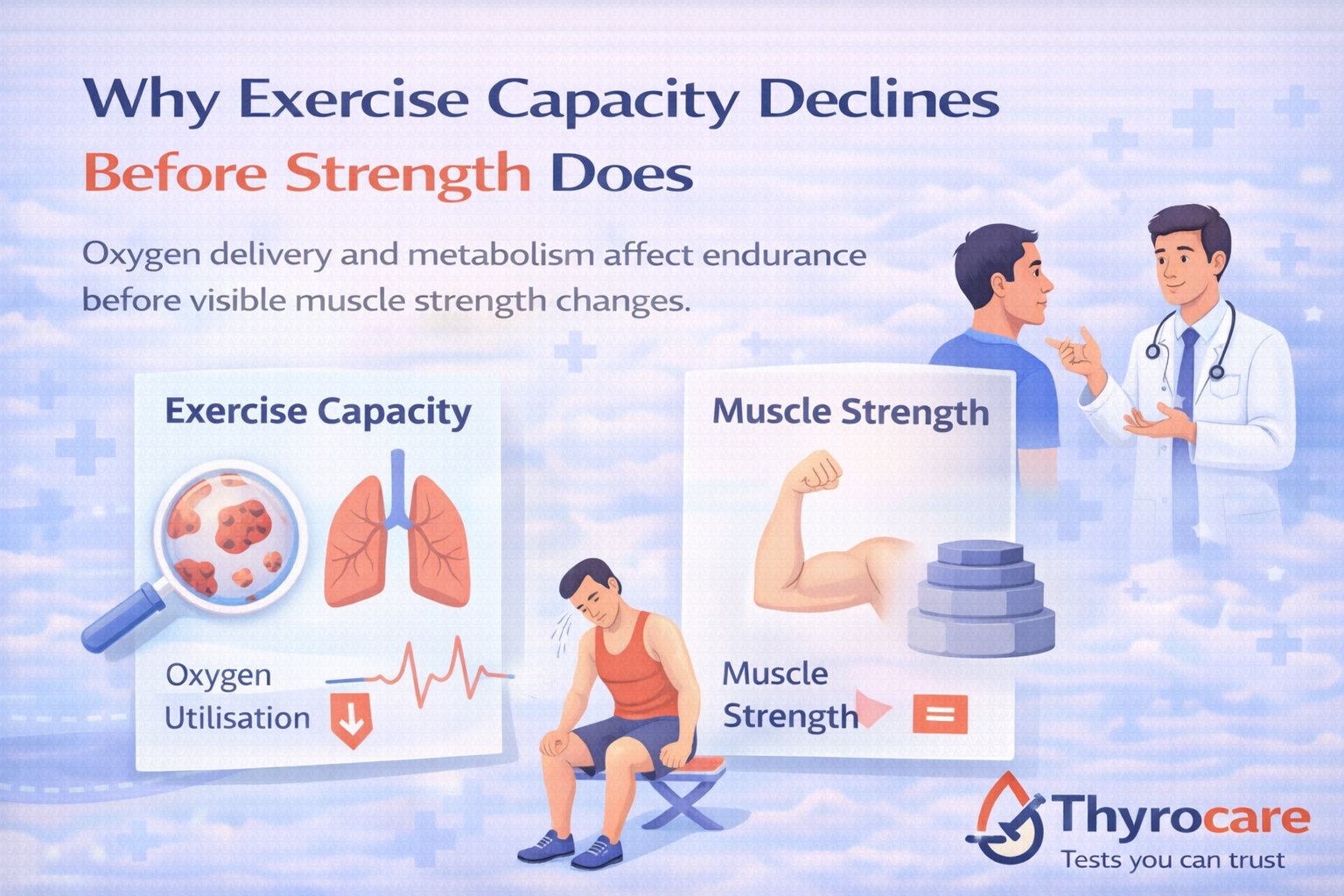
Why Exercise Capacity Declines Before Strength Does
Many people are surprised when workouts start feeling harder even though their muscle strength seems unchanged. Lifting the same weights or performing routine movements may still feel manageable, yet stamina drops, breathing feels heavier, or recovery takes longer. This isn’t a fitness failure—it’s often a sign that exercise capacity declines before visible strength does.
Strength and Capacity Are Not the Same
Muscle strength refers to how much force muscles can generate. Exercise capacity, on the other hand, reflects how efficiently the body delivers oxygen, produces energy, and sustains activity over time. Capacity depends on coordination between the lungs, blood, heart, and metabolism. Because these systems adapt silently, capacity often declines long before muscles show weakness.
The Role of Oxygen Utilisation
During physical activity, muscles rely on oxygen to produce energy. Even when muscles are strong, reduced oxygen delivery can limit performance. This may show up as early breathlessness, quicker fatigue, or difficulty maintaining pace. These changes often occur subtly and are easy to dismiss as “being out of shape.”
Hemoglobin Efficiency and Circulation
Hemoglobin plays a critical role in transporting oxygen through the bloodstream. If oxygen delivery becomes less efficient—even slightly—exercise capacity is affected first. Circulation efficiency also matters; when blood flow doesn’t meet increased demand during activity, endurance drops despite preserved muscle strength.
Early Metabolic Limits Appear Quietly
Energy production involves complex metabolic pathways. When these systems become less efficient, the body reaches its limits sooner during exertion. This doesn’t immediately impact strength-based tasks, which require short bursts of effort, but it significantly affects sustained activity like walking long distances, climbing stairs, or continuous workouts.
Why These Changes Are Often Missed
Because strength remains intact, early declines in capacity are frequently overlooked. Many people adjust unconsciously—slowing down, taking more breaks, or avoiding endurance-heavy activity—without realising an internal shift has occurred.
How Blood Tests Add Clarity
Blood markers related to oxygen transport, circulation, and metabolism help explain why capacity changes before strength. These internal indicators provide insight into how efficiently the body supports physical activity, even when outward fitness appears unchanged.
Understanding Exercise Capacity with Thyrocare
Thyrocare offers blood tests that assess parameters linked to oxygen delivery, hemoglobin efficiency, and metabolic balance. When you book a Thyrocare blood test through BookMyTest, samples are collected at home and digital reports are delivered within 24 to 48 hours, supporting early understanding of changes that affect physical performance.
Conclusion
Exercise capacity often declines quietly, long before strength does. Changes in oxygen utilisation, circulation, and metabolism affect how the body sustains activity—even when muscles remain strong. Recognising this difference helps shift focus from appearance and strength alone to the internal systems that truly drive endurance and long-term physical performance.
FAQs
Why does exercise feel harder even when strength seems normal?
Because endurance depends on oxygen delivery and metabolism, not just muscle strength.
Can blood tests explain reduced exercise capacity?
Yes. A Thyrocare blood test can reveal markers related to oxygen transport and metabolic efficiency.
Is Thyrocare home sample collection available for fitness-related testing?
Yes. Thyrocare home sample collection is available when booked through BookMyTest.
Does reduced capacity always mean poor fitness?
Not necessarily. Internal efficiency can change without visible loss of strength or fitness.
How quickly are Thyrocare blood test reports delivered?
Most Thyrocare blood test reports are shared digitally within 24 to 48 hours.